




Is the latest creation from AMD, codenamed ‘Bulldozer’ their greatest CPU yet? We take a look at FX-8120 and find out as we put it through its paces.

Product on Review: AMD Bulldozer FX-8120
Manufacturer and Sponsor: AMD
Street price: £120 inc. VAT (At time of review)
AMD Bulldozer is the worlds first native, eight core, desktop processor. Since the days of Intel releasing their Core2Duo CPUs and later on, their Core2Quad CPUs, AMD have been trailing behind. Although they have been able to offer CPUs with more cores than Intels’ equivalent for a similar or cheaper price, they have not been able to match Intel in the performance sector. Intel have been consistently improving their designs and they have left AMD in the dust.
Whilst Intel have been focusing on driving down their wattage that their CPUs run at and increasing the performance at the same time, AMD have stuck to a similar wattage specification whilst trying to increase their performance at the same time.
We have gone from a 45nm architecture on Phenom II to a 32nm architecture on Bulldozer which should have brought both improved power consumption figures to the table, as well as a design which can be clocked at higher speeds. However, the only FX CPU out of the entire FX line up that delivers on a higher clock speed is the FX-8150. Granted that the turbo features do boost the core speeds above and beyond the Phenom IIs’ range, it should have been possible to reach these speeds without the need for the turbo.
The wattage ranges from 95 to 125 watts which is no improvement over Phenom II. Granted there are many more transistors within the chip (~1.2B), but Intel have managed to bring down their TDP and improve their performance so we wonder why AMD have not been able to pull this off as well.
AMD’s Overview of Bulldozer
We call it the new AMD FX 8-Core Processor Black Edition and it’s unlocked for your overclocking pleasure. Experience unmatched multitasking and pure core performance with the industry’s first 32nm 8-core desktop processor. Get the speed you crave with AMD Turbo CORE Technology to push your core frequencies to the limit when you need it most. Go beyond the limits of maximum speed with easy-to-use AMD OverDrive™ and AMD Catalyst Control Center™ software suites. But the best part of all? You’ll get all this impressive performance at an unbelievable price. You’ll be asking yourself “what competition?” in no time.
Features & Specifications
AMD FX 8-Core Processors
The industry’s first and only native 8-core desktop processor for unmatched multitasking and pure core performance with all-new CPU architecture.
New 32 nanometer die shrink designed to reduce leakage for improved efficiency, increased clock rate headroom and better thermals.
AMD Turbo CORE Technology
The AMD FX Processors come equipped with AMD Turbo CORE Technology. AMD Turbo CORE Technology is a performance boosting technology that helps increase performance on the applications that need it the most.
New Instruction Capabilities
AVX
Advanced Vector Extensions increase parallelism tailored for scientific and 3D applications that use heavy floating point calculations
FMA4 and XOP
Floating Point Vector Multiply -Accumulate improves throughput and performance on many vector functions (integer and floating point)
AES
Advanced Encryption Standard noticeably increase performance on the latest encryption applications like TrueCrypt and benchmarks like PCMark
AMD Balanced Smart Cache
Shared L3 cache ( up to 8MB)
Improved scheduling and pre-fetch capabilities
64-ways (16-ways/sub-cache)
Increased data queue sizes
Coherency for 8-cores
AMD Wide Floating Point Accelerator
Shared FP Scheduler
Dual 128-bit Floating point engines – capable of teaming together for 256-bit AVX instructions or operating separately with each core.
HyperTransport™ Technology
One 16-bit link at up to 5600MT/s
Up to 8.0GB/s HyperTransport™ I/O bandwidth; Up to 16GB/s in HyperTransport Generation 3.0 mode
Up to 37GB/s total delivered processor-to-system bandwidth (HyperTransport bus + memory bus)
Benefit: Quick access times to system I/O for better performance.
Integrated DRAM Controller with AMD Memory Optimizer Technology
A high-bandwidth, low-latency integrated memory controller
Supports up to DDR3-18662
Supports new low voltage memories of 1.35V and 1.2V
Up to 29.9GB/s memory bandwidth for DDR3
New Pre-Fetcher improvements
Direct communications to each core in Dual-Core module (APIC registers in each core)
Benefit: Optimized memory controller to feed more cores
AMD Virtualization™ (AMD-V™) Technology with IOMMU
Silicon feature-set enhancements designed to improve the performance, reliability, and security of existing and future virtualization environments by allowing virtualized applications with direct and rapid access to their allocated memory.
IOMMU is an extension to AMD64 architecture to support address translation and access protection on DMA transfers
Security for User Level application and Virtual Machine guest operating system
Address translation and access control
Device isolation
Device assignment in virtualized systems
Security & trusted boot support
Unified interrupt management
Benefit: Helps virtualization software to run more securely and efficiently enabling a better experience when dealing with virtual systems
AMD PowerNow!™ Technology (Cool’n’Quiet™ Technology)
Enhanced power management features which automatically and instantaneously adjusts performance states and features based on processor performance requirements
C6 power state for cache flush, and voltage down individual core
CC6 power state allows all cores in C6 to power even lower
For quieter operation and reduced power requirements
Separate memory controller power control
IO-based c-state interface
Works automatically without the need for drivers or BIOS enablement.
Power can be switched on or off within a single clock cycle, saving energy with no impact to performance.
Benefit: Helps users get more efficient performance by dynamically activating or turning off parts of the processor.
The industry’s first and only native 8-core desktop processor for unmatched multitasking and pure core performance with all-new CPU architecture.
New 32 nanometer die shrink designed to reduce leakage for improved efficiency, increased clock rate headroom and better thermals.
AMD Turbo CORE Technology
The AMD FX Processors come equipped with AMD Turbo CORE Technology. AMD Turbo CORE Technology is a performance boosting technology that helps increase performance on the applications that need it the most.
New Instruction Capabilities
AVX
Advanced Vector Extensions increase parallelism tailored for scientific and 3D applications that use heavy floating point calculations
FMA4 and XOP
Floating Point Vector Multiply -Accumulate improves throughput and performance on many vector functions (integer and floating point)
AES
Advanced Encryption Standard noticeably increase performance on the latest encryption applications like TrueCrypt and benchmarks like PCMark
AMD Balanced Smart Cache
Shared L3 cache ( up to 8MB)
Improved scheduling and pre-fetch capabilities
64-ways (16-ways/sub-cache)
Increased data queue sizes
Coherency for 8-cores
AMD Wide Floating Point Accelerator
Shared FP Scheduler
Dual 128-bit Floating point engines – capable of teaming together for 256-bit AVX instructions or operating separately with each core.
HyperTransport™ Technology
One 16-bit link at up to 5600MT/s
Up to 8.0GB/s HyperTransport™ I/O bandwidth; Up to 16GB/s in HyperTransport Generation 3.0 mode
Up to 37GB/s total delivered processor-to-system bandwidth (HyperTransport bus + memory bus)
Benefit: Quick access times to system I/O for better performance.
Integrated DRAM Controller with AMD Memory Optimizer Technology
A high-bandwidth, low-latency integrated memory controller
Supports up to DDR3-18662
Supports new low voltage memories of 1.35V and 1.2V
Up to 29.9GB/s memory bandwidth for DDR3
New Pre-Fetcher improvements
Direct communications to each core in Dual-Core module (APIC registers in each core)
Benefit: Optimized memory controller to feed more cores
AMD Virtualization™ (AMD-V™) Technology with IOMMU
Silicon feature-set enhancements designed to improve the performance, reliability, and security of existing and future virtualization environments by allowing virtualized applications with direct and rapid access to their allocated memory.
IOMMU is an extension to AMD64 architecture to support address translation and access protection on DMA transfers
Security for User Level application and Virtual Machine guest operating system
Address translation and access control
Device isolation
Device assignment in virtualized systems
Security & trusted boot support
Unified interrupt management
Benefit: Helps virtualization software to run more securely and efficiently enabling a better experience when dealing with virtual systems
AMD PowerNow!™ Technology (Cool’n’Quiet™ Technology)
Enhanced power management features which automatically and instantaneously adjusts performance states and features based on processor performance requirements
C6 power state for cache flush, and voltage down individual core
CC6 power state allows all cores in C6 to power even lower
For quieter operation and reduced power requirements
Separate memory controller power control
IO-based c-state interface
Works automatically without the need for drivers or BIOS enablement.
Power can be switched on or off within a single clock cycle, saving energy with no impact to performance.
Benefit: Helps users get more efficient performance by dynamically activating or turning off parts of the processor.
Packaging & A Closer Look
AMD have done something different to what they usually do with their processor boxes. They are now metal containers which is a nice touch but I feel that it is rather unnecessary as it just increases the overall costs. Although it is nice, it is a seemingly pointless idea as most of us take a CPU out of its box, install it, and never look at the box again unless it is time to sell or upgrade the CPU.
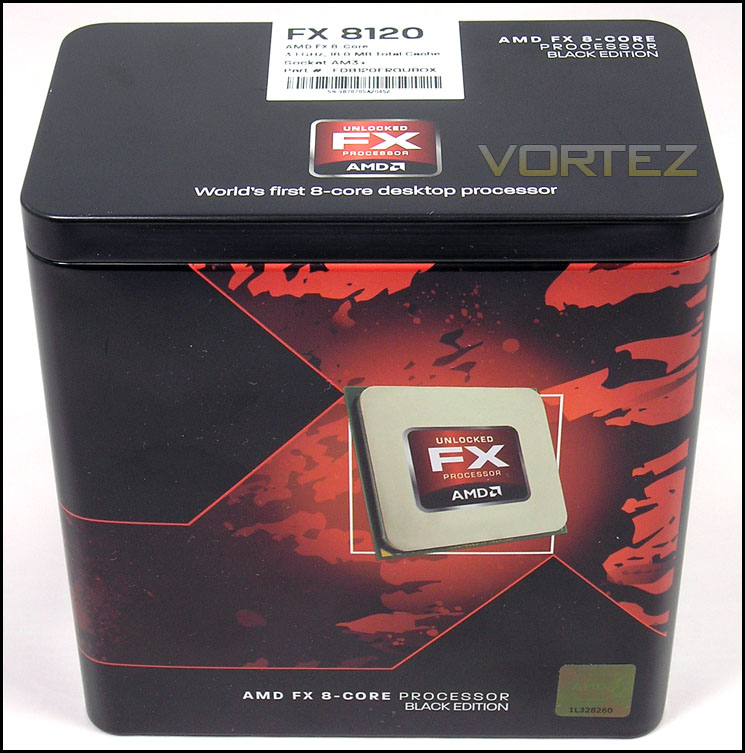
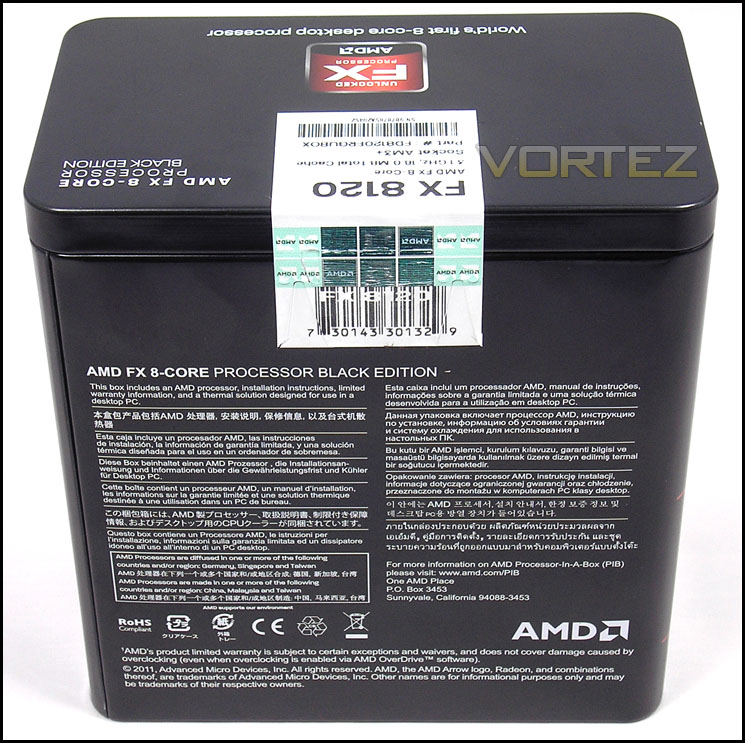
Once you open up the box it comes in, you will be greeted with a CPU cooler, a warranty/installation guide, the CPU itself and an AMD FX sticker for your case.
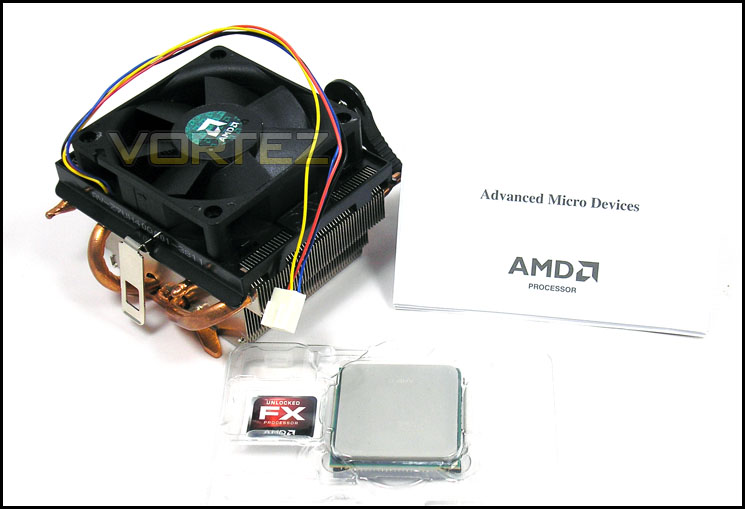
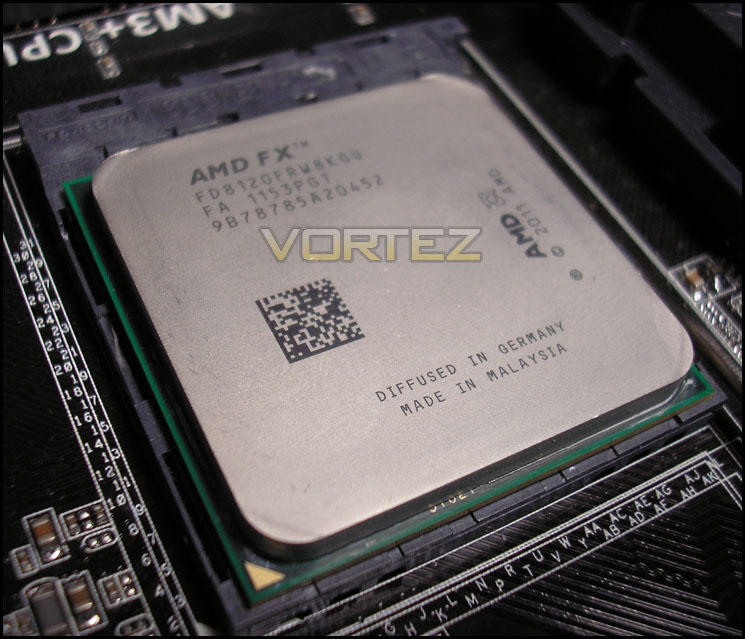
Below, we have a shot which is up close to the CPU to show you what it looks like when it is installed into a motherboard. In our case, it is installed into our test bench motherboard which is the ASUS M5A99X EVO which we have previously reviewed.
Test Setup & Benchmarks
Our test benches consist of the following components:
AMD Bulldozer FX-8120 Test Bench
CPU – AMD FX-8120 Eight-Core Processor
Cooling – Noctua NH-D14
Motherboard – ASUS M5A99X EVO
Memory – G.SKILL RipJawX DDR3-1866MHz CL9
Graphics – ZOTAC GTX 570 1280MB
Storage – Corsair Force F120
PSU – FSP Aurum CM Series 750W 80PLUS Gold
CPU – AMD FX-8120 Eight-Core Processor
Cooling – Noctua NH-D14
Motherboard – ASUS M5A99X EVO
Memory – G.SKILL RipJawX DDR3-1866MHz CL9
Graphics – ZOTAC GTX 570 1280MB
Storage – Corsair Force F120
PSU – FSP Aurum CM Series 750W 80PLUS Gold
AMD Phenom II 955 Test Bench
CPU – AMD Phenom II 955
Cooling – Noctua NH-D14
Motherboard – ASUS M5A99X EVO
Memory – G.SKILL RipJawX DDR3-1866MHz CL9
Graphics – ZOTAC GTX 570 1280MB
Storage – Corsair Force F120
PSU – FSP Aurum CM Series 750W 80PLUS Gold
CPU – AMD Phenom II 955
Cooling – Noctua NH-D14
Motherboard – ASUS M5A99X EVO
Memory – G.SKILL RipJawX DDR3-1866MHz CL9
Graphics – ZOTAC GTX 570 1280MB
Storage – Corsair Force F120
PSU – FSP Aurum CM Series 750W 80PLUS Gold
Before we start any overclocking, we will be setting the BIOS to the following defaults before beginning any overclocking.
Overclocking Settings
CPU Multiplier – 11.5x
RAM speed – 1066MHz
CPU/NB and HT Links – 1600MHz (8x CPU bus)
CPU Multiplier – 11.5x
RAM speed – 1066MHz
CPU/NB and HT Links – 1600MHz (8x CPU bus)
For all of our AMD CPU reviews, we will be running the following benchmarks to give you a varied array of results to best portray the CPU(s).
AIDA64 – CPU benchmarks
X264 HD 5.0.1 – 1st and 2nd pass encoding
SiSoftware Sandra 2012 – CPU and Memory benchmarks
CineBench 11.5 – CPU score
3DMark 11 – DX11 3D Performance and Extreme preset
Games – Crysis 2, DiRT Showdown, Skyrim and Sleeping Dogs
X264 HD 5.0.1 – 1st and 2nd pass encoding
SiSoftware Sandra 2012 – CPU and Memory benchmarks
CineBench 11.5 – CPU score
3DMark 11 – DX11 3D Performance and Extreme preset
Games – Crysis 2, DiRT Showdown, Skyrim and Sleeping Dogs
Overclocking
The manufacturing process is down to 32nm now with the Bulldozer CPUs compared to that of Phenom II which is 45nm. This entails that due to the smaller architecture, it should be both cooler running and it should use less power. With that in mind, it should also mean that overclocking headroom is increased. Lets take a look at what the results say…
In order to make sure that our results were comparable to the Phenom II sample we have, we had to limit the CPU multiplier to 11.5x on both CPUs. The AMD Phenom II 955 which we have can only go to around 3.8GHz before it becomes unstable and no amount of voltage tweaking could get any more out of the system. It is most likely due to it being a C2 revision as the C3 revised chips overclocked much better. Our AMD Bulldozer FX-8120 sample on the other hand is capable of 4.5GHz, fully stable, and it will run anything we throw at it. So, improved overclocking definitely is there, as expected.
Below is an image of the two CPU-Z shots of each chip, side by side. This is what configuration we are going to be running for this review.
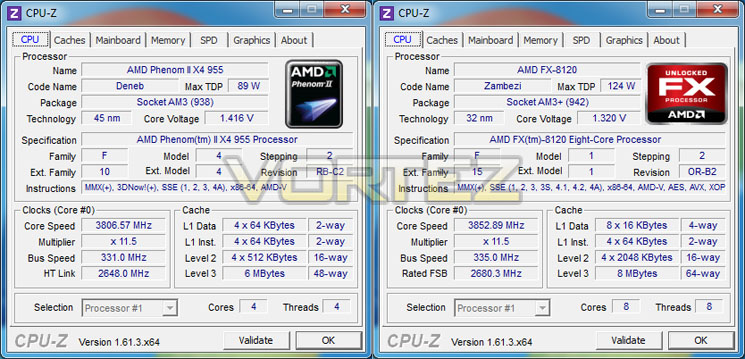
Lets talk overclocking. In terms of how easy it was to overclock either CPU, they were both just as easy as each other. We were able to get an extra 4MHz out of the CPU bus with the AMD Bulldozer FX-8120 but this is as far as it would go. It is most likely down to a motherboard limitation and/or CPU limitation as they are pushing the chipset and CPU extremely hard at this point. So it is fair to say that the overclocking being slightly better is most likely down to the CPUs rather than the design.
The AMD Phenom II range of quad cores were known to start to hit thermal and voltage limitations once they hit the 4 or 4.2GHz barrier with the later C3 revisions of chips flying off of the shelves. So, to be able to take eight cores to 4.5GHz with less voltage is some achievement. However, will the increase in speed and double the amount of cores translate into a large performance increase? Lets find out…
Power Consumption
It’s interesting to note the power consumption across all processors. First of all, for the idle tests the system is cold booted into Windows and no additional applications are executed – the watts are noted on the external energy monitor we use and then the system is loaded with 3DMark 11 – watts are again monitored for the duration of the test and the highest rated wattage result is then noted down. Below are the results of this energy test.
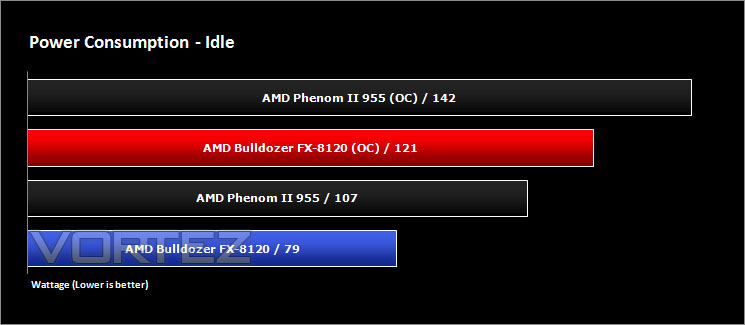
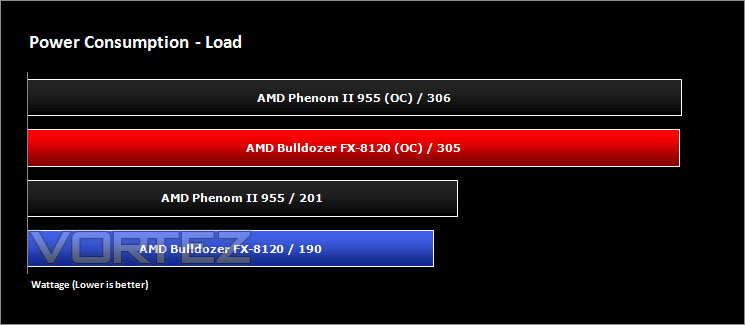
AMD have reduced the power of the Bulldozer chip considerably when compared to the Phenom II range of CPUs when both the chips are left at stock (BIOS defaults with tweaked RAM timings and voltages) speeds.
In an idle state, the CPU is using 26% less power in comparison to the AMD Phenom II 955 and 15% less power when it is overclocked. The main reason for this is that both CPUs are running at near identical clock speeds but the AMD Bulldozer FX-8120 requires a lot less voltage to do it. This is down to the 32nm architecture compared to the 45nm architecture of the AMD Phenom II range.
However, in a load state, things balance out and the lead that the chip should have, is not there. At stock speeds, just like before but in a 100% loaded state, there is only a 5% reduction in power usage. Taking a look at the overclocked speeds and wattage, although it is set to 0.1v less in the BIOS, it is only saving us roughly 1 watt of power.
Benchmarks: AIDA64
This simple integer benchmark focuses on the branch prediction capabilities and the misprediction penalties of the CPU. It finds the solutions for the classic “Queens problem” on a 10 by 10 sized chessboard. At the same clock speed theoretically the processor with the shorter pipeline and smaller misprediction penalties will attain higher benchmark scores. For example – with HyperThreading disabled – the Intel Northwood core processors get higher scores than the Intel Prescott core based ones due to the 20-step vs. 31-step long pipeline. The CPU Queen test uses integer MMX, SSE2 and SSSE3 optimizations.
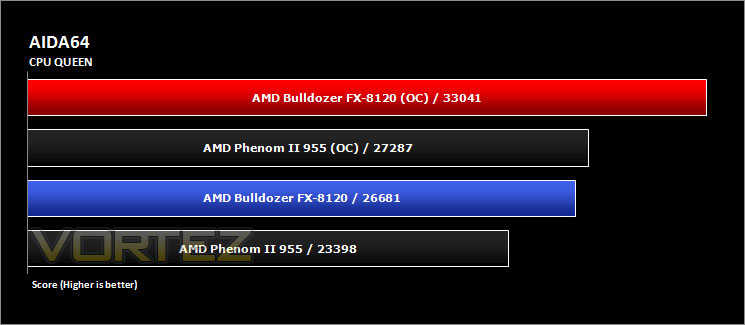
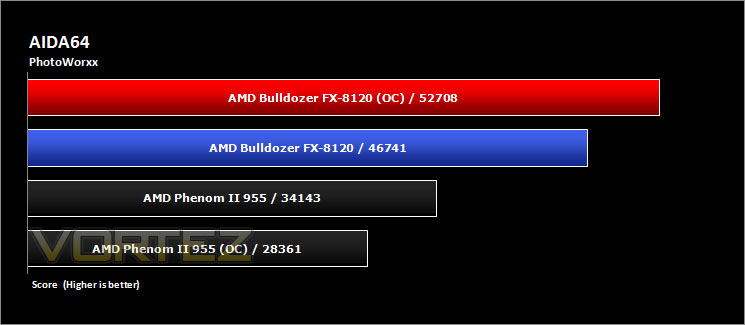
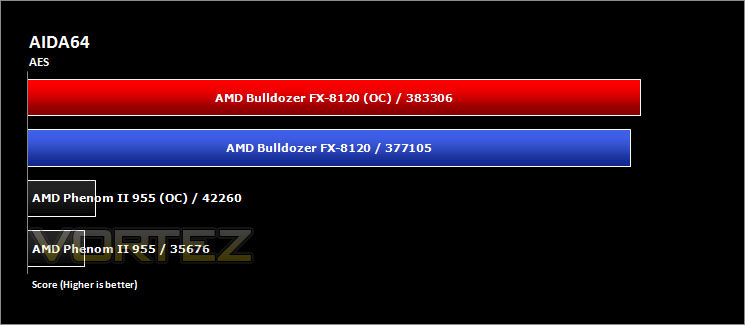
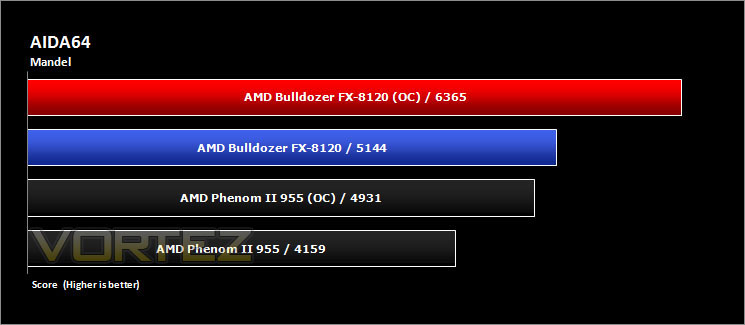
In all of the benchmarks which we run from the AIDA64 suite, it is obvious that more cores equate to better performance across the board.
Benchmarks: CINEBENCH 11.5
CINEBENCH can measure systems with up to 64 processor threads. This test scene contains approximately 2,000 objects which in turn contain more than 300,000 polygons in total, and uses sharp and blurred reflections, area lights, shadows, procedural shaders, antialiasing, and much more. The result is displayed in points (pts). The higher the number, the faster your processor is.
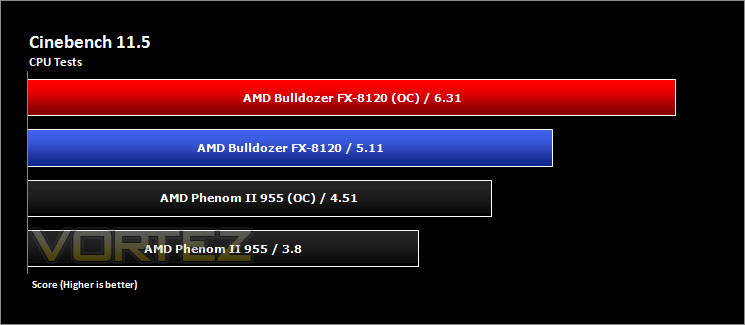
CINEBENCH produces better scores when more cores are used as it is designed to be able to utilise up to 64 processor threads at any one time. This benchmark favours higher core numbers as well as increased clock speeds.
Benchmarks: SiSoftware SANDRA 2012
SANDRA isn’t always a benchmark that is included in hardware reviews but we believe it shouldn’t be ignored. SANDRA provides a vigorous package that tests your system in a rather large array of benchmarks. There are many aspects of benchmark that can be executed. We will be considering the CPU and memory tests.
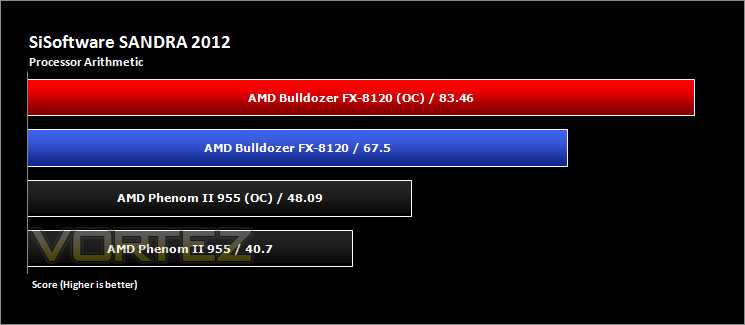
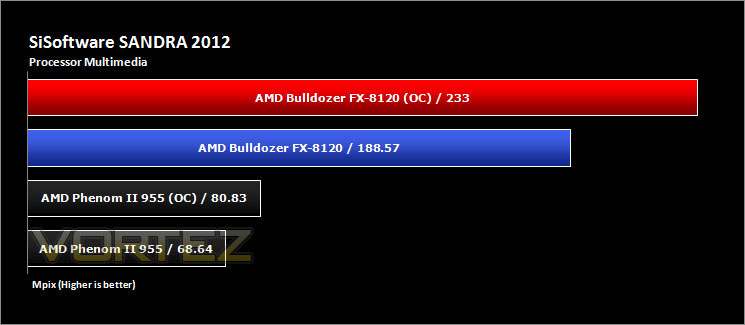
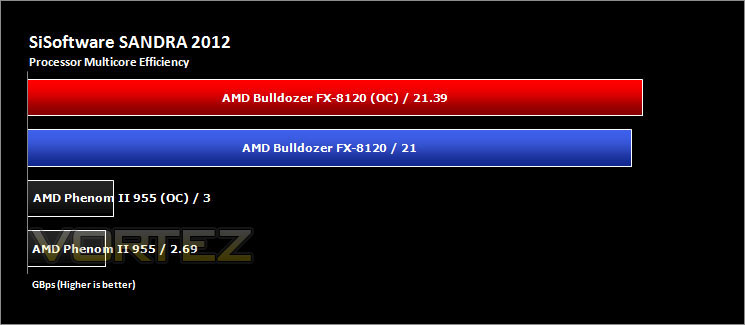
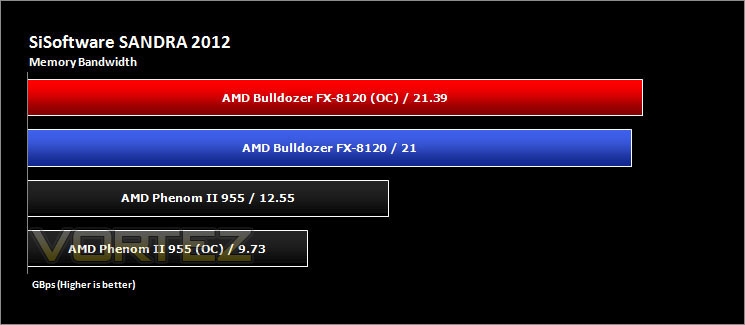
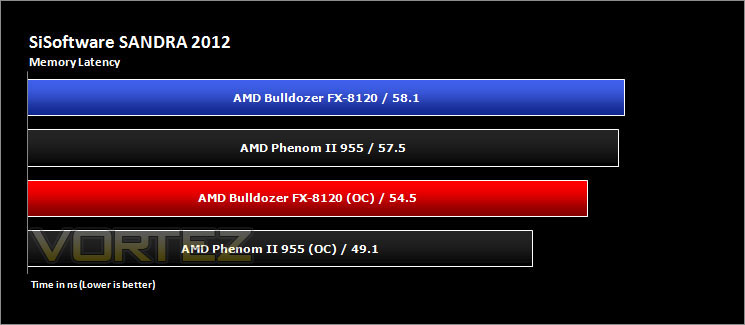
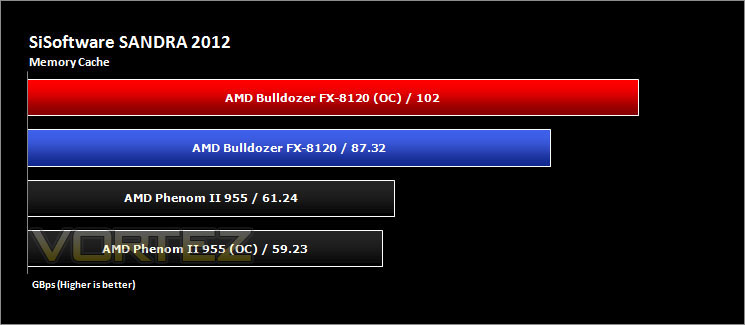
For the vast majority of the SiSoftware SANDRA benchmarks that we run, the Bulldozer CPU is better than its predecessor. However, when the memory latency is tested, Bulldozer is actually slower than its older brother, Phenom II.
3D Benchmarks: 3DMark 11
Designed to measure your PC’s gaming performance 3DMark 11 makes extensive use of all the new features in DirectX 11 including tessellation, compute shaders and multi-threading. Trusted by gamers worldwide to give accurate and unbiased results, 3DMark 11 is the best way to consistently and reliably test DirectX 11 under game-like loads.
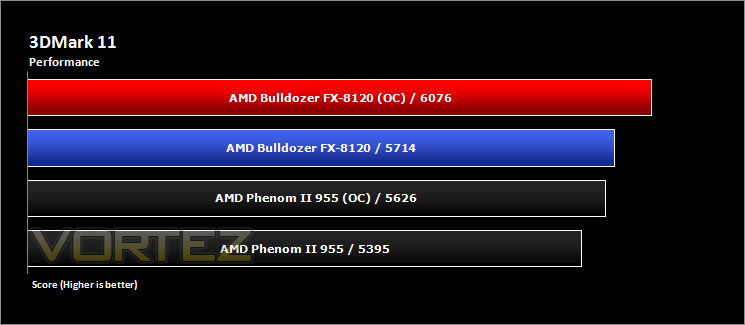
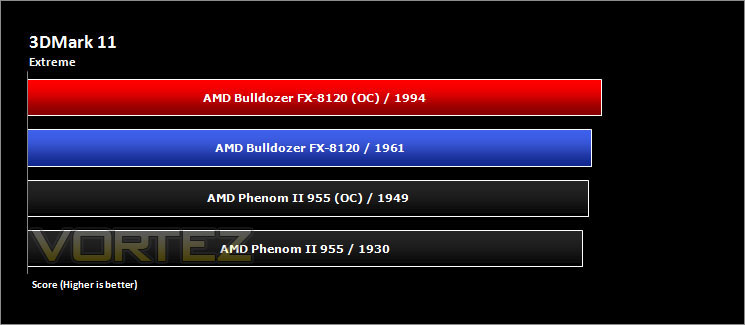
3DMark11 has always preferred more cores as it allows it to process the CPU parts faster. It is apparent that the Bulldozer CPU wins in this race but the differences are not as great as you may have expected.
3D Benchmarks: Unigine Heaven 3.0
Unigine’s benchmark is to showcase the benefits of DX 11 and the use of tessellation as opposed to normal rendering techniques. The demo has impressive visuals that give an insight into what we can expect from gaming in the future.
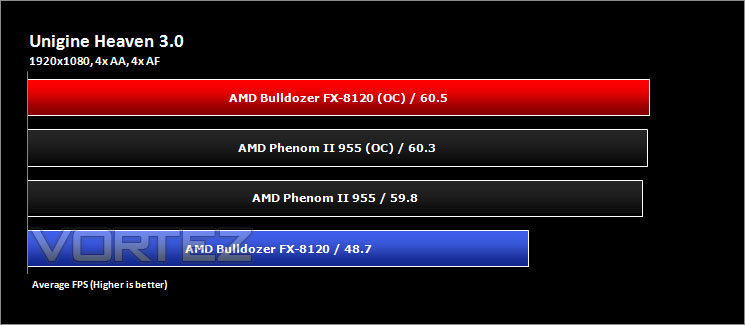
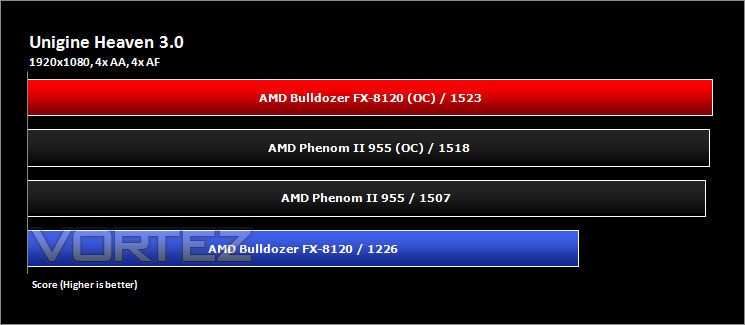
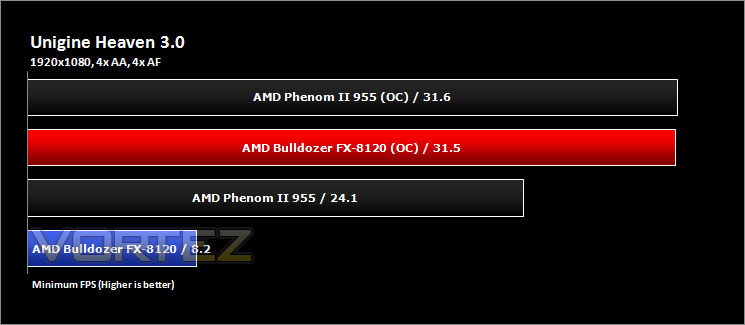
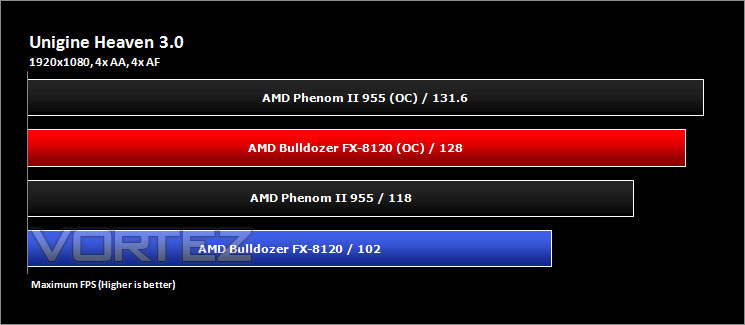
Unigine Heaven 3.0 is more graphics bound than CPU bound in our case which means that the CPUs are fairly close in both stock and overclocked circumstances. For some reason, our system would not play nicely at stock when we benchmarked the Bulldozer chip and it gave us a horrible score. It did not change, even after rerunning it several times.
Gaming Benchmarks: Crysis 2 & DiRT Showdown
It’s important for us to perform a number of game benchmarks as well as the synthetic tests because it allows us to test the 3D performance. So here we have some popular titles, critically acclaimed and action-packed. FRAPS and in-house benchmarking tools were used to capture average FPS.
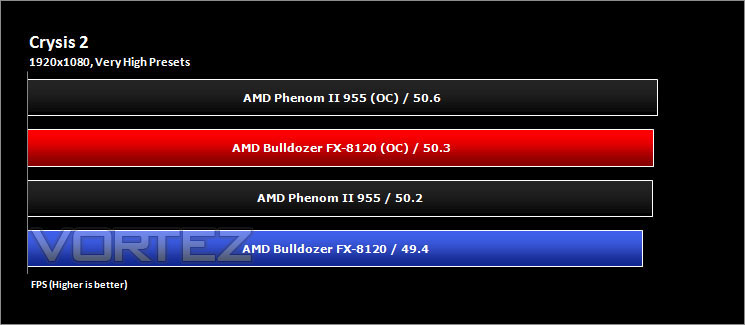
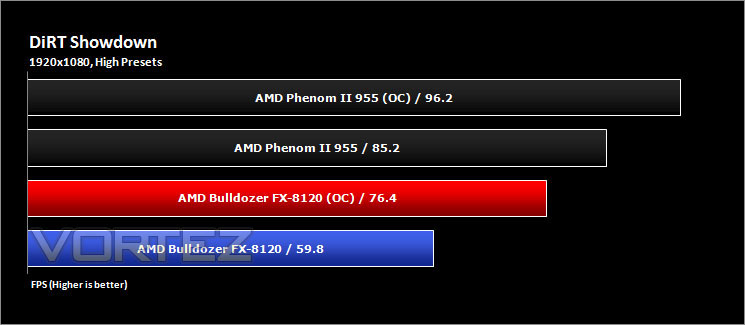
In both games, as shown above, the Bulldozer chip performs worse than Phenom II, even though when it was overclocked, its core clock speed was a little higher.
Gaming Benchmarks: Skyrim & SleepingDogs
It’s important for us to perform a number of game benchmarks as well as the synthetic tests because it allows us to test the 3D performance. So here we have some popular titles, critically acclaimed and action-packed. FRAPS and in-house benchmarking tools were used to capture average FPS.
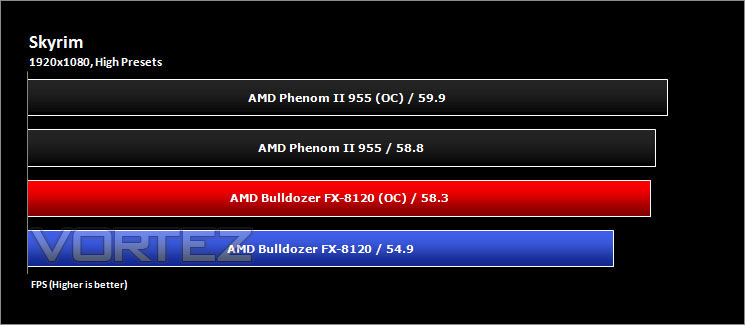
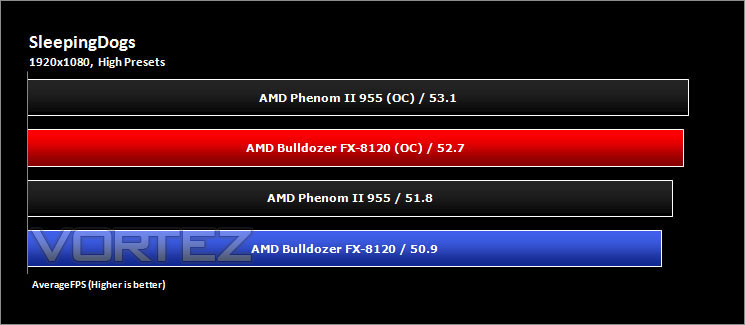
The exact same story here as the previous two games benchmarks. The Bulldozer CPU cannot match Phenom II.
Conclusion
The AMD Bulldozer architecture certainly has its advantages when the applications can utilise all of the cores and threads when you compare it to their older Phenom II range of processors. However, in certain games, it does appear to perform worse. Even though they were running at nigh on identical speeds, the Phenom II still has the edge in gaming which is a shame.
Lets talk about the results. As demonstrated in our benchmarks, many of them favour as many cores as you can chuck their way. The more the merrier in that case so the AMD Bulldozer architecture has an easy win in the bag. When it comes down to the gaming benchmarks which we ran, the advantages are not so obvious and in some cases, the CPU actually performs worse when compared to its four year old brother, Phenom II.
Power consumption is definitely on the decline which is good to see – but the story changes when you overclock the CPU. As mentioned previously in the power consumption part of this review; the idle power usage at stock is roughly 26% lower than its Phenom II counterpart, and it is roughly 15% lower when the system is overclocked. Once you start to overclock and put the system under CPU under 100% load, the story changes. Although there is a difference of 0.1v between the two chips, the power hungry Bulldozer CPU catches up with the Phenom II and the margins decrease dramatically.
However, lets cut to the chase and give you our view on the processor. The AMD Bulldozer FX-8120 CPUs have twice the amount of cores compared to the Intel equivalents. It uses more power. It does not perform very well in the gaming benchmarks which we have put the system through and it still remains nowhere near as powerful as anticipated. Although we have not included any direct comparisons in this review, we can compare it to our previous reviews of the 3570K and 3770K review which we posted earlier this year.
The power consumption on the AMD Bulldozer FX-8120 compared to the 3770K as it is at a similar clock speed in our previous review, we cannot directly compare them as there is a different PSU in use, and a different GPU which will plague a fair game if we were to do a direct comparison. Instead, we will compare the difference between idle and load wattage as only the CPU was stressed when we take our measurements. On the AMD system, there is a difference of 184w between the idle and loaded states. In direct comparison, there is only a 138w difference between the idle and load states of the Intel Core i7 3770K. By my calculations, that works out to a 25% difference in power usage. Obviously these are just rough numbers due to different PSUs being used in each system but I think a variance of 2 to 3 per cent at best would be the difference we would see. So essentially, it is anywhere from 22 to 28% less power efficient than the Intel CPUs.
Although there are some very distinctive improvements in performance over the four year old generation known as Phenom II, there are still some issues that AMD need to iron out. The main improvements are in multithreaded applications, simply because there are more cores and threads to do the work. The gaming performance needs to improve drastically if they want to be in any shape to compete against Intel. As it currently stands, a four core Intel Core i5 3570K outperforms this eight core AMD Bulldozer CPU in almost every single test, because the IPC is so much higher in comparison.
Even though the AMD Bulldozer FX-8120 features twice the number of cores when compared to the Intel Core i5 3570K, it still cannot compete against it. At stock speeds, the AMD chip averages roughly 60FPS less than the Intel chip in the first passing – but it is on par with the Intel chip in the second passing of the test. Once the CPU is overclocked, the story remains the same with roughly 60FPS between AMD and Intel in the first pass and ever so slightly faster in the second pass.
Time to wrap up this rather long winded conclusion. If you are in the market for a new system, and you have nothing to upgrade from, it is extremely difficult to recommend this processor over the Intel Core i5 3570K. Granted it does cost more, roughly 35% more for the CPU alone, and whether that difference in performance is worth it to you is entirely up to you at the end of the day. To us, it makes perfect economical sense to get the Intel chip over the AMD chip as it uses less power which will save you money in the long run. It also stands in its own league of performance and unfortunately, AMD have yet to give us anything to come close to it. AMD was hyped up and they were making it sound as if this was a true Intel trouncer. Unfortunately, it did not live up to the hype. Realistically, AMD should be able to match Intel with their Westmere CPUs which are now four years old. They do not come close to it.
In my views, the days of AMD being a high performance competitor in the industry are coming to an end unless they really work their magic with Piledriver. We will be doing a very thorough comparison between Bulldozer and Piledriver, when it arrives.
Unfortunately, due to all of the downsides of Bulldozer, we personally feel that it deserves no more than a bronze medal. It had so much potential but ultimately, it failed to deliver.

Pros
+ Improved idle power consumption over Phenom II
+ Nicely packaged
Cons
– Struggles to match a four year old design
– Uses a lot of power
– Poor performance/watt ratio
– Gets defeated by CPUs with half the cores
+ Improved idle power consumption over Phenom II
+ Nicely packaged
Cons
– Struggles to match a four year old design
– Uses a lot of power
– Poor performance/watt ratio
– Gets defeated by CPUs with half the cores


