







Driven by the Sandforce SF-2281 controller, how will Intel’s latest Solid State Drive aka Cherryville compare against the might of other popular SSDs?

Product on Review: Intel 520 Series
Manufacturer : Intel
Street Price: £611inc. VAT (At time of review)
Intel’s 520 SSD aka Cherryville is the latest rendition of consumer SSD. With their previous 510 Series they relied upon Marvell for their controller but with the 520 Series Intel has switched to SandForce in a bid to deliver amazing performance, better efficiency and reliability.
Intel claim this is their fastest SSD solution yet, combining the speed of the popular SF-2281 controller used in many popular SSDs and Intel’s very own 25nm NAND flash.
We’ve heard some very good things about the Intel 520 Series and we are pleased to be bringing you a review of this today. Expectations are high, can the 520 deliver? Let’s find out!
Intel’s words on 520 Series
Stay ahead of the competition when you level up to 6.0 gigabits per second (Gb/s) performance. Intel® Solid-State Drives (Intel® SSDs) continue to evolve with the Intel SSD 500 Family. Available in a wide range of capacities, the Intel® Solid-State Drive 520 Series offers built-in data protection features and delivers exceptional performance over hard drives.
Technical Specifications
Specifications
• 60GB, 120GB, 180GB, 240GB and 480GB capacities
• SandForce SF-2281 SSD processor
• SATA 6.0 Gbps interface
• Up to 550MB/s sequential read speeds
• Up to 520MB/s sequential write speeds
• Maximum 4K random write: 80,000 IOPS
• TRIM Support
Features
SandForce SF-2200 series SSD processor paired with qualified MLC NAND flash for best performance, value and reliability
SATA 6Gb/s, 3Gb/s and 1.5Gb/s
TRIM support (O/S dependent)
Intelligent Block Management and Wear Leveling
Intelligent Read Disturb Management
Intelligent “Recycling” for advance free space management (Garbage Collection)
Intelligent Data Retention optimization
ECC protection for longest data retention and drive life.
Power/Performance Balancing
Thermal Threshold Management
Native Command Queuing (NCQ) – Up to 32 commands
ECC Recovery: Up to 55 bits correctable per 512-byte sector (BCH)
Sequential Read & Write Transfer:
60GB model; Up to 550MB/s read | 475MB/s Write
120GB models; 550MB/s read | 500MB/s Write
180/240/480GB models; 550MB/s read | 520MB/s Write
Max Random Write IOPS:
60GB model; Up to 80K (4K aligned)
O/S Support: Windows® XP / Vista / 7 / Mac® OS / Linux
• 60GB, 120GB, 180GB, 240GB and 480GB capacities
• SandForce SF-2281 SSD processor
• SATA 6.0 Gbps interface
• Up to 550MB/s sequential read speeds
• Up to 520MB/s sequential write speeds
• Maximum 4K random write: 80,000 IOPS
• TRIM Support
Features
SandForce SF-2200 series SSD processor paired with qualified MLC NAND flash for best performance, value and reliability
SATA 6Gb/s, 3Gb/s and 1.5Gb/s
TRIM support (O/S dependent)
Intelligent Block Management and Wear Leveling
Intelligent Read Disturb Management
Intelligent “Recycling” for advance free space management (Garbage Collection)
Intelligent Data Retention optimization
ECC protection for longest data retention and drive life.
Power/Performance Balancing
Thermal Threshold Management
Native Command Queuing (NCQ) – Up to 32 commands
ECC Recovery: Up to 55 bits correctable per 512-byte sector (BCH)
Sequential Read & Write Transfer:
60GB model; Up to 550MB/s read | 475MB/s Write
120GB models; 550MB/s read | 500MB/s Write
180/240/480GB models; 550MB/s read | 520MB/s Write
Max Random Write IOPS:
60GB model; Up to 80K (4K aligned)
O/S Support: Windows® XP / Vista / 7 / Mac® OS / Linux
Packaging, Bundle & Closer Look
The 520 Series is presented in a similarly designed package as per Intel’s processors. The front of the packaging refers to the type of drive this is and the total capacity. The rear of the box has further technical details.
Inside, the SSD has been placed inside a well packaged box and is retained within an anti-static bag.
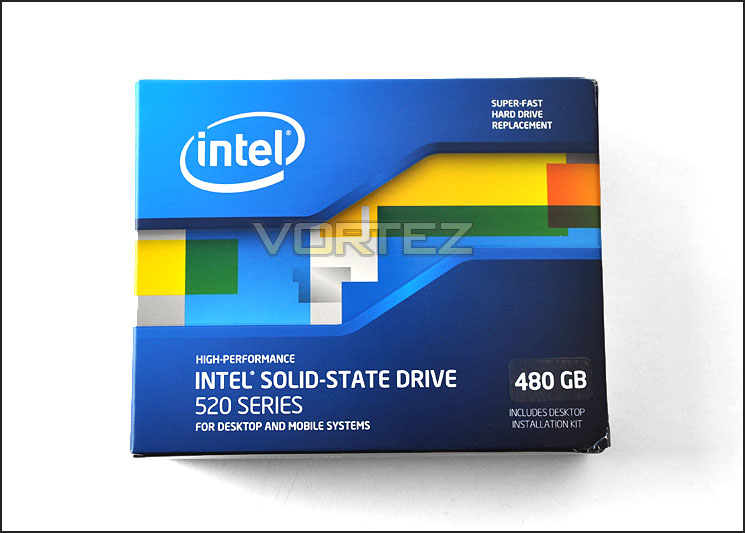
The packaging for the Intel 520 Series
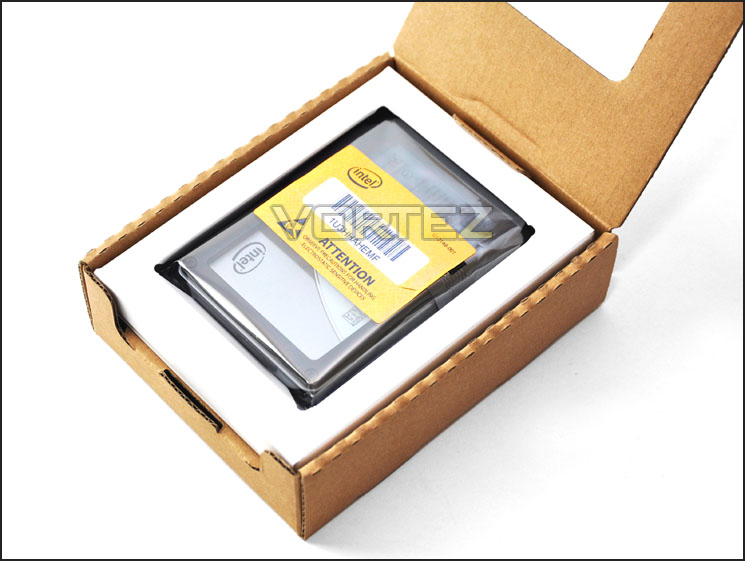
The SSD is well protected
For an SSD there is quite an assortment of bundled accessories with the 520 Series. The included items consist of:
• 2.5” to 3.5” drive adapter
• Molex to SATA adapter
• SATA 6GB/s cable
• Migration software CD with installation guide
• Speed Demon sticker
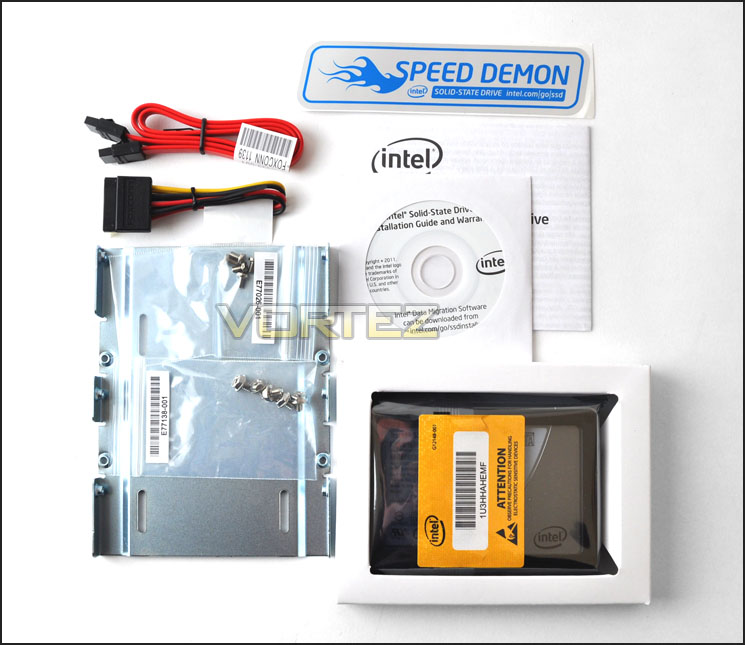
The accessories bundle for Intel 520
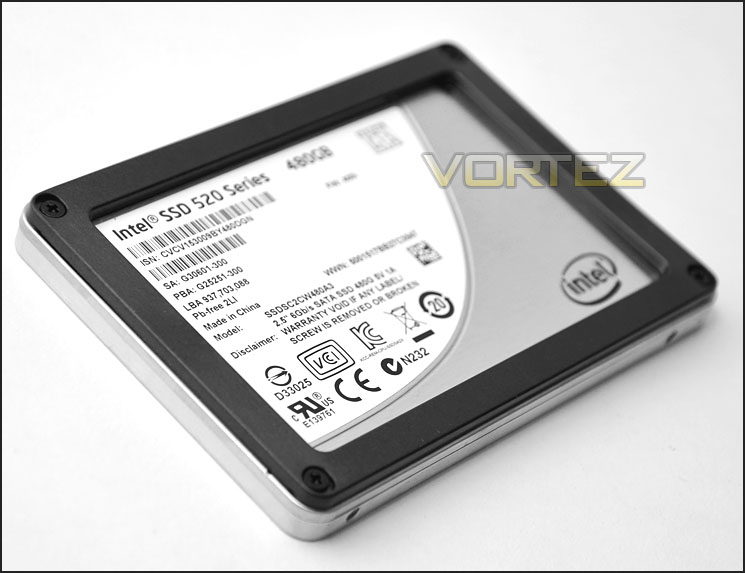
With the packaging out of the way we can finally take a look at the SSD itself. The 520 Series has a rather lack-lustre visual appearance. The aesthetics are purely with functionality in mind. The edge has been given a plastic border whilst the innards have a brushed metal surface. The front has a label detailing the serial number and capacity. The various standards that have been adhered to have been placed on the front label too.
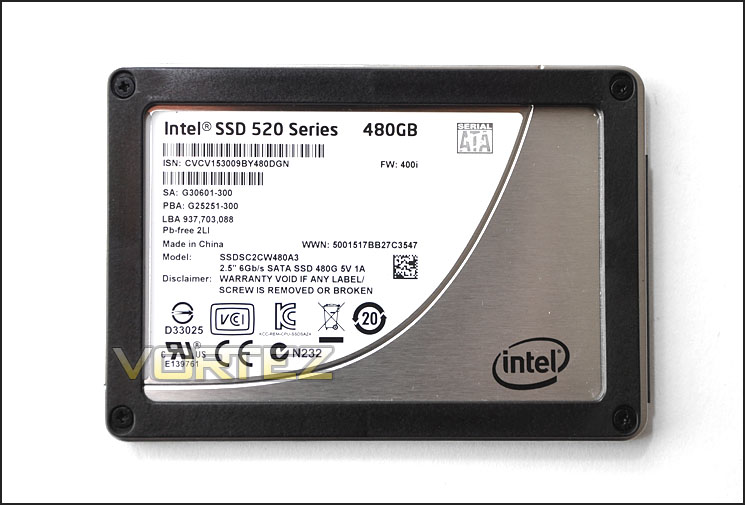
The front of Intel 520 Series
Spinning the drive over onto the rear side, Intel hasn’t treated this side with any type of finish. It is in a dull, untreated state as per the image below. There are 4x mounting holes for attaching this drive to the mounting bracket provided or within the computer chassis if your choice.
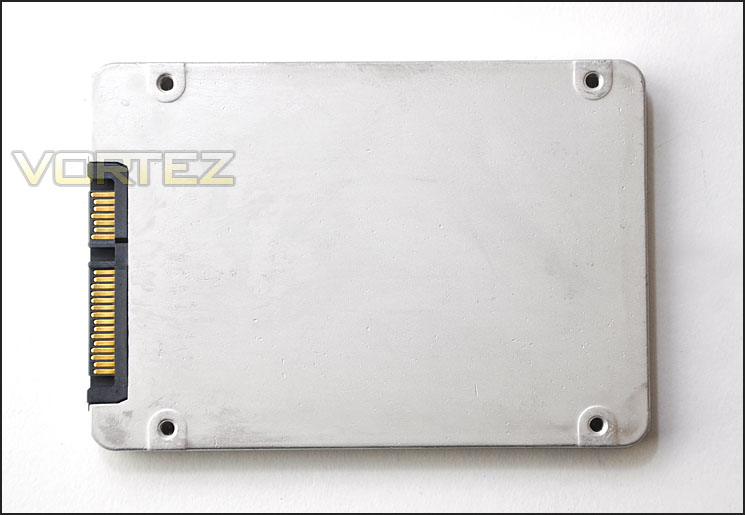
The rear of Intel 520 Series
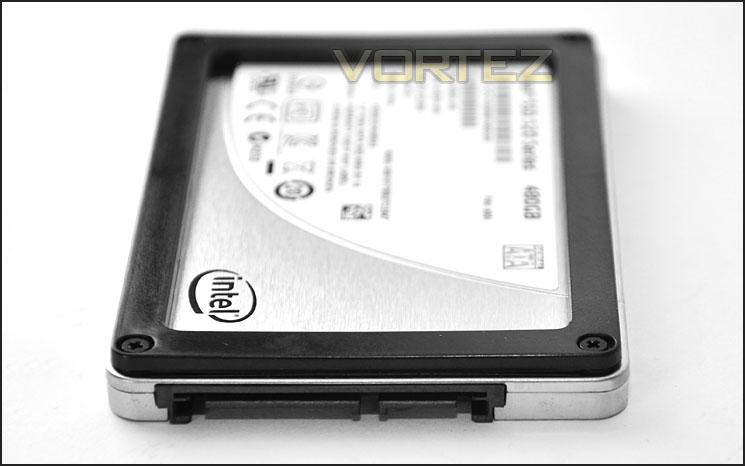
The surface of the SSD with protective border and brushed metal shell
At the centre of the Intel SSD 520 is SandForce SF-2281 controller. This controller is also used with Corsair Force 3, Kingston HyperX, Patriot Pyro and other popular SSDs.
The NAND flash used on the Intel 520 is 25nm Intel 29F16B08CCME2. Intel has selected the best NAND and assures enthusiasts these are of the best you can get.
With the inspection now over let’s see how 520 performs whilst under testing conditions against a list of rival drives.
Testing Methodologies
Our SSDs have recently been moved to a new test system as the Intel P67 setup has been decommissioned for the newer Intel Z77. As a result, the database whilst still having a reasonable number of test subjects to compare against isn’t as extensive as we would like so keep a look out over the coming weeks for more additions!
The system is formatted and a fresh version of Windows is installed with just drives in place – no additional applications. Windows is then updated to the latest release and the drivers are installed. Included in the list of benchmarks are the following applications:
ATTO Disk Benchmark v2.46
AS SSD
CrystalDiskMark 3.0
Iometer
SiSoftware SANDRA 2012
Windows 7 Boot Time Test
Test system
CPU Intel Core i5 2500K
Motherboard MSI Z77A-GD65
Graphics MSI R7970 Black Edition
Memory 8GB Corsair Vengeance 2133MHz
HDD
– Intel 520 480GB (Sata 6Gbps)
– Kingston HyperX 3K 120GB (Sata Gbps)
– Kingston HyperX 240GB (Sata 6Gbps)
– ADATA S510 120GB (Sata 6Gbps)
– Samsung 830 Series 256GB (Sata 6Gbps)
– Samsung HD103SJ 1TB (Sata 3Gbps)
PSU OCZ 750W Fatal1ty
OS Microsoft Windows 7 Professional 64-Bit
CPU Intel Core i5 2500K
Motherboard MSI Z77A-GD65
Graphics MSI R7970 Black Edition
Memory 8GB Corsair Vengeance 2133MHz
HDD
– Intel 520 480GB (Sata 6Gbps)
– Kingston HyperX 3K 120GB (Sata Gbps)
– Kingston HyperX 240GB (Sata 6Gbps)
– ADATA S510 120GB (Sata 6Gbps)
– Samsung 830 Series 256GB (Sata 6Gbps)
– Samsung HD103SJ 1TB (Sata 3Gbps)
PSU OCZ 750W Fatal1ty
OS Microsoft Windows 7 Professional 64-Bit
Benchmarks: ATTO Disk Benchmark v2.46
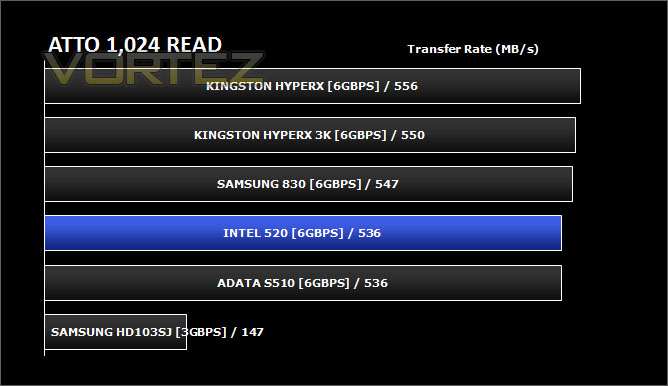
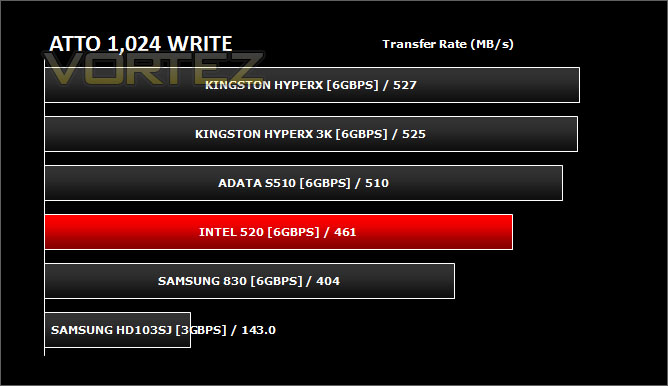
The ATTO Disk Benchmark performance measurement tool is compatible with Microsoft Windows. Measure your storage systems performance with various transfer sizes and test lengths for reads and writes. Several options are available to customize your performance measurement including queue depth, overlapped I/O and even a comparison mode with the option to run continuously. Use ATTO Disk Benchmark to test any manufacturers RAID controllers, storage controllers, host adapters, hard drives and SSD drives and notice that ATTO products will consistently provide the highest level of performance to your storage.
Benchmarks: AS SSD
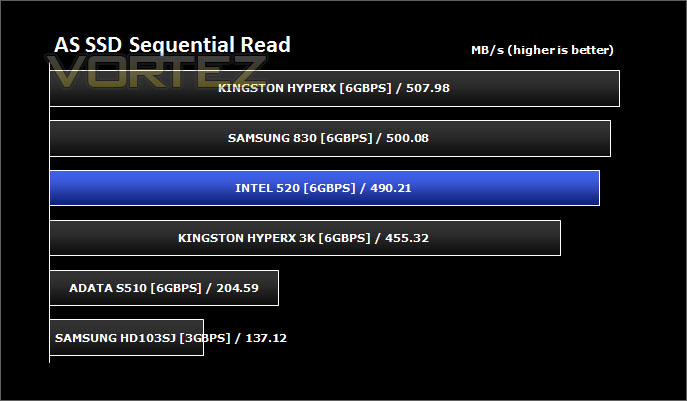
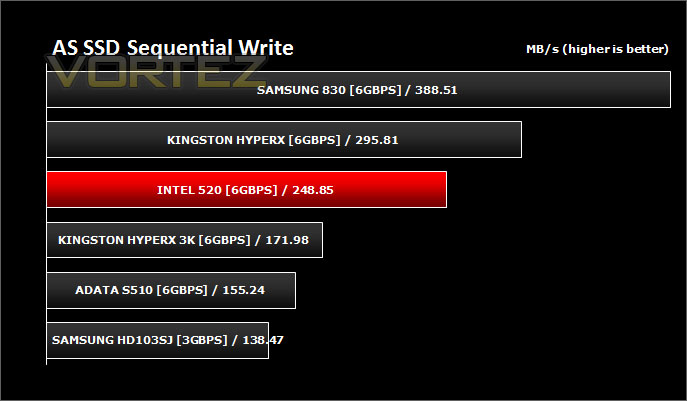
AS SSD Benchmark is a straightforward tool for measuring the speed of your SSD drive.
Simply launch the program, choose your drive, click Start, and it’ll test your SSD’s read and write speed in a variety of ways, delivering a score for each when it’s done. And if that’s not enough, there are also additional file copy and compression-related benchmarks available from the Tools menu. (The author’s support page is German only, but if you need further English explanations then there’s a thread on the program at the OCZ Technology forum.).
Simply launch the program, choose your drive, click Start, and it’ll test your SSD’s read and write speed in a variety of ways, delivering a score for each when it’s done. And if that’s not enough, there are also additional file copy and compression-related benchmarks available from the Tools menu. (The author’s support page is German only, but if you need further English explanations then there’s a thread on the program at the OCZ Technology forum.).
Benchmarks: CrystalDiskMark 3.0
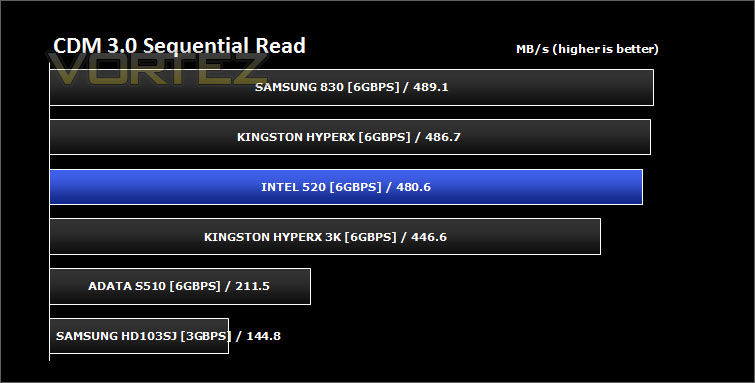
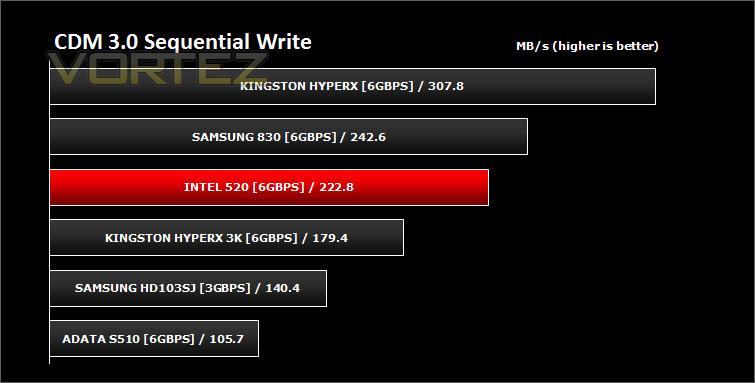
CrystalDiskMark is a disk benchmark software that analyses different types of hard drive. Giving sequential benchmark write and read statistics in MB/s. A simple program that is very useful.

Benchmarks: IOMeter
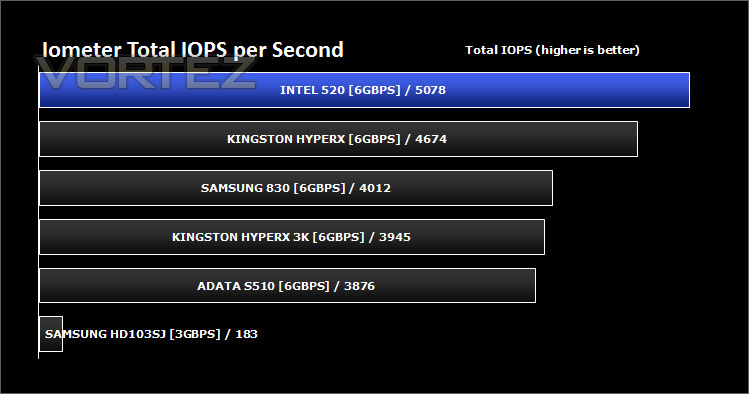
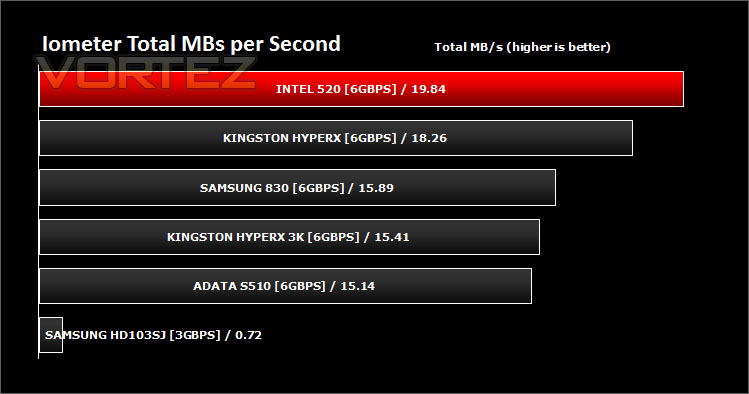
Iometer is based on a client–server model, where one instance of the Iometer graphical user interface is managing multiple ‘workers’ (each one representing a separate Dynamo.exe process) which are doing the I/O. Iometer performs Asynchronous I/O – accessing files or block devices (later one allowing to bypass the file system buffers).
Iometer allows the configuration of disk parameters such as the ‘Maximum Disk Size’, ‘Starting Disk Sector’ and ‘# of Outstanding I/Os’. This allows a user to configure a test file upon which the ‘Access Specifications’ configure the I/O types to the file.
Iometer allows the configuration of disk parameters such as the ‘Maximum Disk Size’, ‘Starting Disk Sector’ and ‘# of Outstanding I/Os’. This allows a user to configure a test file upon which the ‘Access Specifications’ configure the I/O types to the file.
For the purpose of this test. The 4K 50%/50% read/write file will be under the examination with 100% Random Distribution – reporting back on IOPS and MBs per Second.
Benchmarks: SiSoftware SANDRA 2012
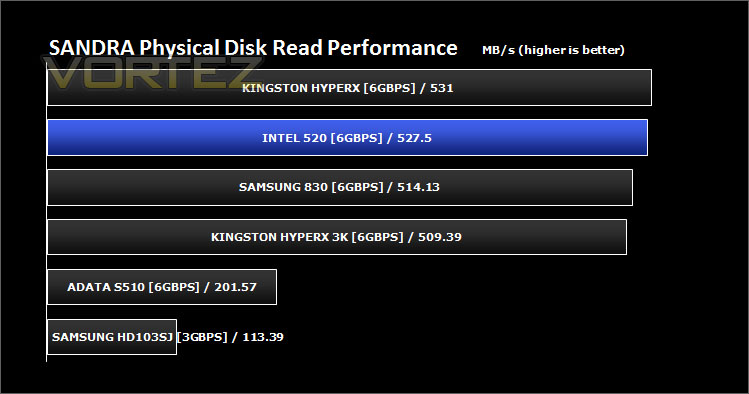
SiSoftware Sandra (the System ANalyser, Diagnostic and Reporting Assistant) is an information & diagnostic utility. It should provide most of the information (including undocumented) you need to know about your hardware, software and other devices whether hardware or software.
Sandra is a (girl) name of Greek origin that means “defender”, “helper of mankind”. We think that’s quite fitting.
It works along the lines of other Windows utilities, however it tries to go beyond them and show you more of what’s really going on. Giving the user the ability to draw comparisons at both a high and low-level. You can get information about the CPU, chipset, video adapter, ports, printers, sound card, memory, network, Windows internals, AGP, PCI, PCI-X, PCIe (PCI Express), database, USB, USB2, 1394/Firewire, etc.
Sandra is a (girl) name of Greek origin that means “defender”, “helper of mankind”. We think that’s quite fitting.
It works along the lines of other Windows utilities, however it tries to go beyond them and show you more of what’s really going on. Giving the user the ability to draw comparisons at both a high and low-level. You can get information about the CPU, chipset, video adapter, ports, printers, sound card, memory, network, Windows internals, AGP, PCI, PCI-X, PCIe (PCI Express), database, USB, USB2, 1394/Firewire, etc.
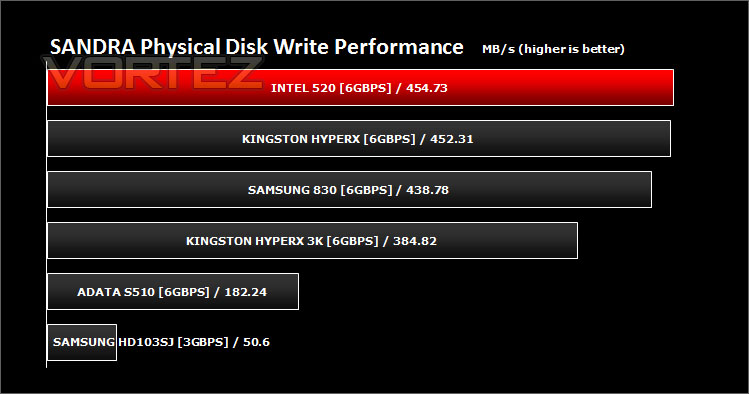
Benchmarks: Windows 7 Boot
Synthetic testing is valuable in the examination of Solid State Drives. But some of the tests may not mean all that much to some readers so the final test in this review is a real world test showing the Windows 7 boot time.
In order to perform this test (and indeed all other benchmarks), a fresh install of Windows 7 Professional was installed on the 520 Series – the image of this install with no additional applications or drivers was exported for importing onto each drive at the time of testing. This will provide a clean and fair environment for comparing the boot times on each of the drives. The times were monitored using a stopwatch.
In order to perform this test (and indeed all other benchmarks), a fresh install of Windows 7 Professional was installed on the 520 Series – the image of this install with no additional applications or drivers was exported for importing onto each drive at the time of testing. This will provide a clean and fair environment for comparing the boot times on each of the drives. The times were monitored using a stopwatch.
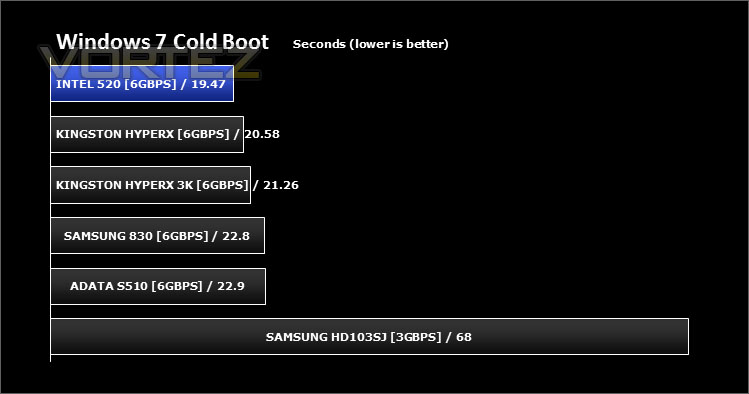
Conclusion
Intel’s 520 Series has, since its arrival taken a firm hold in the SSD consumer SSD market and its obvious to see why.
It may have an unobtrusive visual appearance but the 520 Series’ package and performance is everything to shout about. Intel has been generous and thoughtful with the packaging and bundle by going the extra mile and giving an adapters, cable, mounting plate and other items – something you rarely see nowadays.
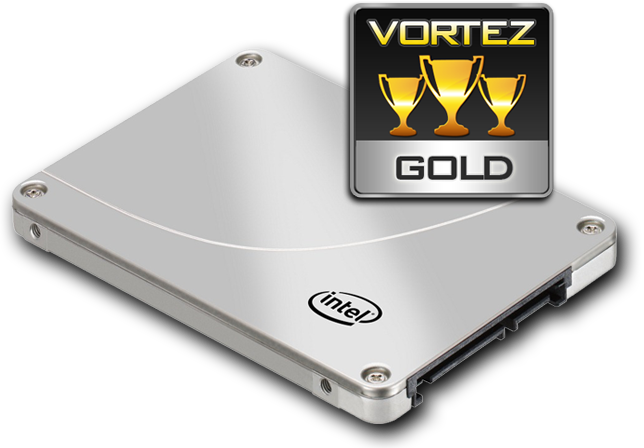
Getting down to the ‘nitty gritty’ the 520 Series does not shy away from presenting impressive performance results. Right across the board – the benchmark reports were very pleasing indeed. We often see some of the drives dip in performance when faced with Sequential Read/Write tasks but the 520 Series proved itself a worthy contender for the SSD crown.
Intel has moved away from using Marvell as their preferred controller with 520 and opted for the popular Sandforce SF-2281 controller which is used in many popular SSDs and they have utilised their own 25nm NAND flash. The drive we have looked at today is of the biggest capacity Intel supply for the 520 Series and as result is costly compared to the 60/120/240GB models which are just over £1 per GB. The 480GB model reviewed today can be found for just over £600 – something that is likely to only appeal to avid enthusiasts rather than the casual.
Backed with an impressive 5 years warranty, Intel’s 520 Series pushes the boundaries for storage transfer rates and impresses with its sequential read and write stats. If you are looking for one of the best consumer SATA 3 SSDs then this is it.
Pros
+ Excellent overall performance
+ Generous accessories pack
+ 5 years warranty
Cons
– Visual aesthetics are lack-lustre
+ Excellent overall performance
+ Generous accessories pack
+ 5 years warranty
Cons
– Visual aesthetics are lack-lustre

Click here for an explanation of our awards at Vortez.net.

