







Looking for a USB 3.0 flash drive able to operate at the transfer rates of an SSD? The Flash Voyager GTX is a super-fast drive which supports TRIM and S.M.A.R.T.

Product On Review: Voyager GTX
Manufacturer & Sponsor: Corsair
Street Price: £88.25 GBP / $120 USD
A few days ago we reviewed Corsair’s new Voyager Air 2 – a mobile storage drive for media users in the home or on the go and today we are back again looking at another storage device from the multi-award winning brand. As with the Voyager Air 2, Corsair are known for pushing the boundaries and the product which is in the spotlight today is another example of this.
Voyager GTX is a USB 3.0 flash drive with a difference. Corsair has integrated an SSD controller inside this drive along with SSD-grade NAND memory in a bid to deliver blistering speeds which enter the realms of the distinguished Solid State Drive. The question is, will these claims stand up throughout our rigorous testing procedures? Let’s find out!
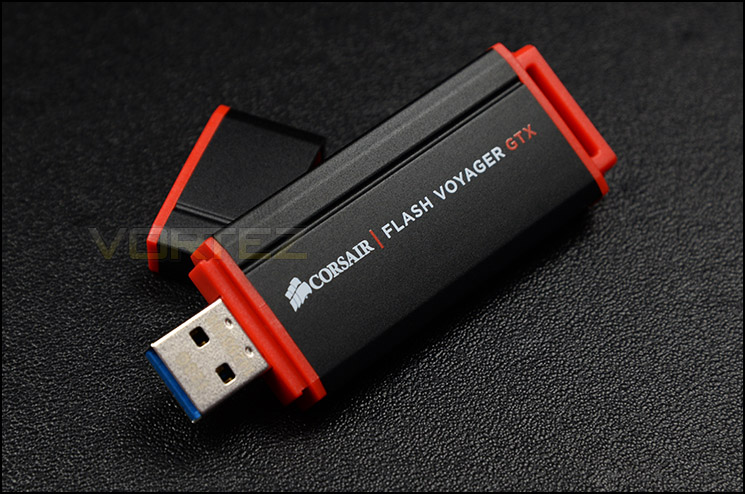
Corsair on their Voyager GTX
Most USB drives are fast… until it’s time to copy a large file and you’re looking at a progress bar that lingers around too long. The solution? Integrate an SSD controller and SSD-grade NAND memory into a drive. Flash Voyager GTX gives you transfer speed that rivals your PC’s solid-state drive. Go ahead and copy those huge files, and spend less quality time with the progress bar.
Technical Specifications
Warranty
Five years
Weight
0.03 kg
Interface
USB 3.0
Unformatted Capacity
128GB
Operating System
Microsoft Windows, Mac OS X and Linux
Shock
40G
Five years
Weight
0.03 kg
Interface
USB 3.0
Unformatted Capacity
128GB
Operating System
Microsoft Windows, Mac OS X and Linux
Shock
40G
Packaging & Closer Look
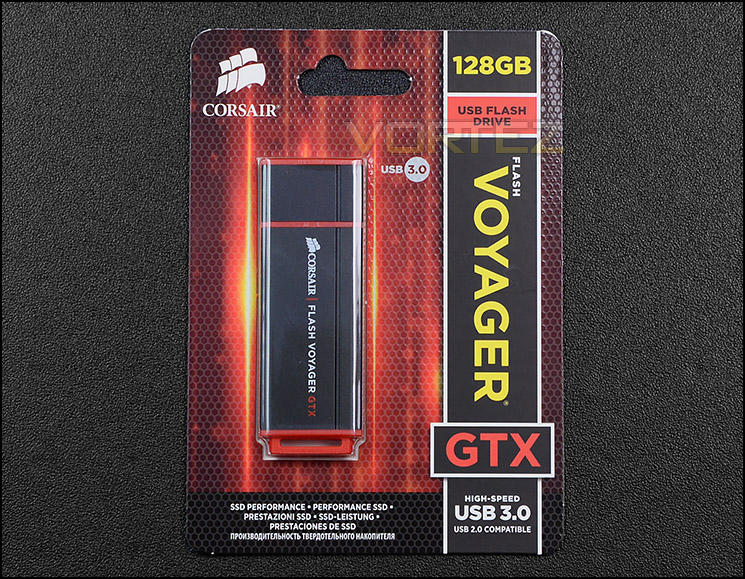
Voyager GTX is packaged within a small packet
Voyager GTX arrives in a small packet which has been designed to capture attention. Corsair has used their performance red throughout the packaging and the actual design of the drive. The front allows a sneak preview of the drive and there are some brief technical specifications round the back with a performance chart. Unfortunately this packet does not open without having to attack it with a knife or sharp implement.
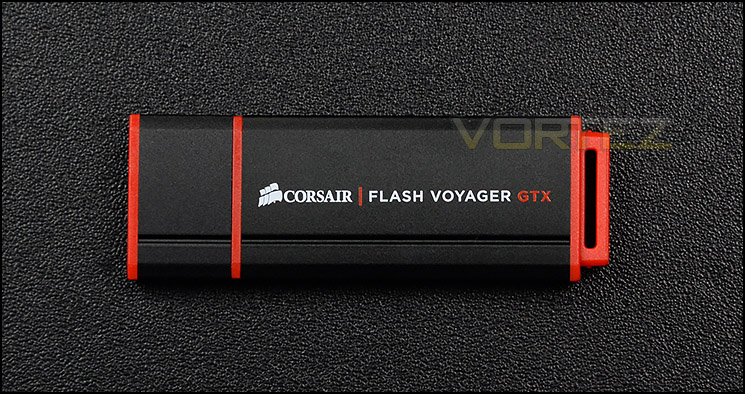
Sleek and durable metal enclosure
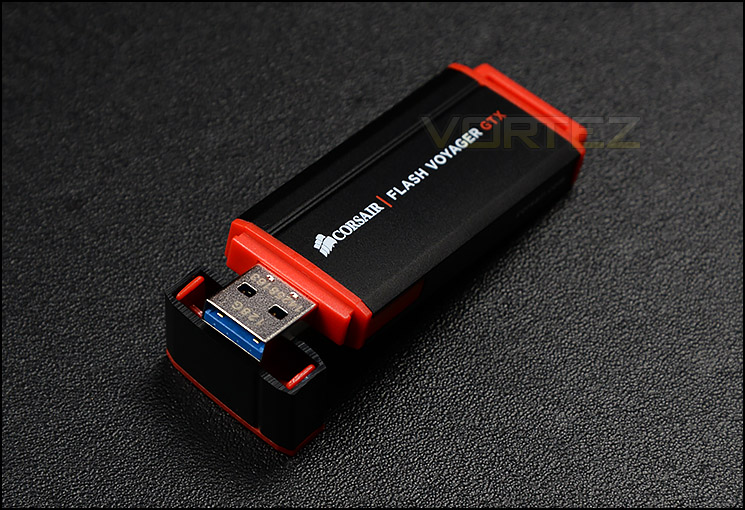
USB 3.0 ready
Unveiling the actual drive itself, Voyager GTX uses a metal enclosure which not only adds a degree of professionalism but ensure utmost durability. Measuring in at 7 x 2.8 x 0.7 cm, Voyager GTX is considerably wider than conventional USB 3.0 pen drives so if your USB ports are horizontally aligned there could be an obstruction.
Our drive uses the USB 3.0 interface but actually utilises an SSD controller in order to deliver ultra-fast performance – even when operating in sequential transfer tasks.
This is what Corsair has to say about Voyager GTX and its internal design:
The Flash Voyager GTX delivers SSD-like performance in a thin USB 3.0 thumb drive. Employing a fully-fledged SSD controller, it produces blistering fast random and sequential transfer speeds and low latency without suffering from the issues with heat or performance consistency found in other high-performance flash drives. It is simply the fastest USB flash drive Corsair has ever produced.
Test Setup & Methodology
Test Setup
CPU Intel Core i7 4790K (Devil’s Canyon)
Cooling Corsair Hydro Series H105
Motherboard ASUS Maximus VII Ranger
Memory 16GB Corsair Vengeance Pro 2800MHz CL12 DDR3
Graphics NVIDIA GTX 780 Ti
Storage OCZ RevoDrive 350 480GB
PSU Corsair HX1050 80 Plus Gold Certified PSU
Cooling Corsair Hydro Series H105
Motherboard ASUS Maximus VII Ranger
Memory 16GB Corsair Vengeance Pro 2800MHz CL12 DDR3
Graphics NVIDIA GTX 780 Ti
Storage OCZ RevoDrive 350 480GB
PSU Corsair HX1050 80 Plus Gold Certified PSU
USB 3.0
The Maximum theoretical bandwidth of USB 3.0 is 5Gbps (625 MB/s); under the most common data encoding parameters this figure drops to ~400MB/s, still dwarfing the spec limits of the majority of USB 3.0 thumb drives. Though the absolute maximum data transfer rate for the drive under reasonable conditions is generally of primary importance, it’s also sensible to monitor sequential performance which is regarded much more rigorous.
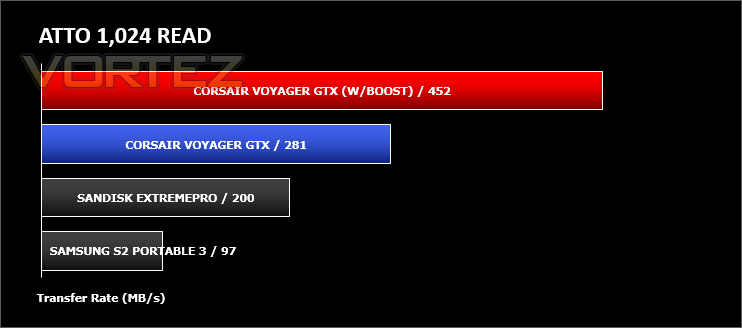
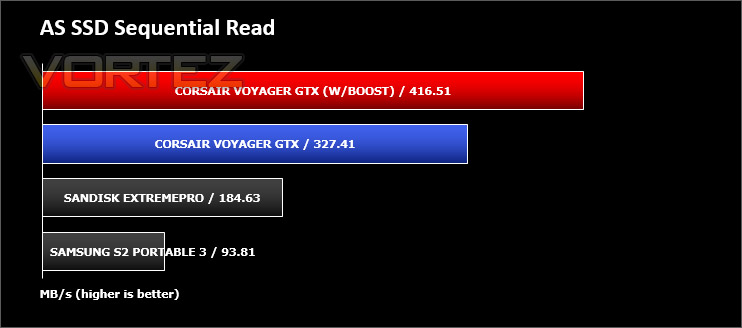
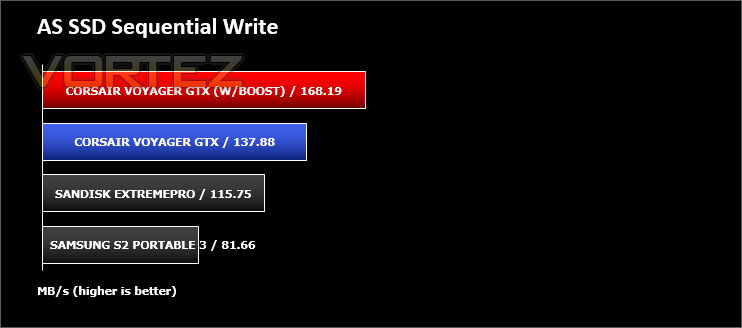
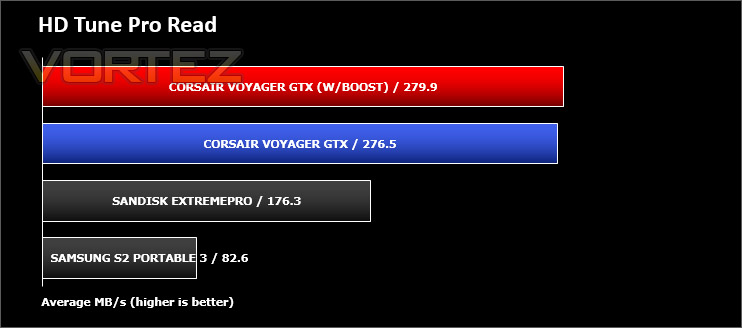
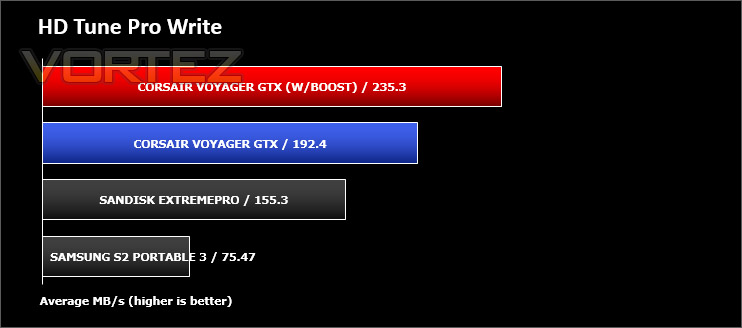
Up against the Voyager GTX we have Samsung’s S2 Portable 3 and Sandisk’s ExtremePRO – two other USB 3.0 flash drives. This comparison helps to demonstrate how a reliable, popular and affordable USB 3.0 drive competes against Corsair’s current fastest USB storage device.
Since Windows 7 does not natively support UASP, results using this operating system can be somewhat restricted. ASUS motherboards unlock UASP via ‘USB 3.0 boost’ as part of AiSuite 3 – we will therefore test both standard and boost performance using Windows 7.
Testing Notes:-
1. Poorly configured or malfunctioning USB 3.0 ports may not recognise USB 3.0 devices, but still work in USB 2.0 mode for USB 2.0 devices. Do not assume that the drive is at fault if this occurs, especially if other USB 3.0 devices have yet to be tested.
2. For reasons unknown, some USB 3.0 ports may be limited to ~135MB/s read/write operation. Though not an issue for most drives, external USB 3.0 SSD enclosures and flash drives which are capable of greater speed will suffer.
Benchmarks: ATTO
The ATTO Disk Benchmark performance measurement tool is compatible with Microsoft Windows. Measure your storage systems performance with various transfer sizes and test lengths for reads and writes. Several options are available to customize your performance measurement including queue depth, overlapped I/O and even a comparison mode with the option to run continuously. Use ATTO Disk Benchmark to test any manufacturers RAID controllers, storage controllers, host adapters, hard drives and SSD drives and notice that ATTO products will consistently provide the highest level of performance to your storage.

Benchmarks: AS SSD
AS SSD Benchmark is a lightweight, yet useful applicationdesigned to help you test the performance of your Solid State Drives using copy and compression tests.
Benchmarks: CrystalDiskMark
CrystalDiskMark is a disk benchmark software that analyses different types of hard drive. Giving sequential benchmark write and read statistics in MB/s. A simple program that is very useful.


Benchmarks: HD Tune Pro
A new utility we have added to our line-up of benchmarks is the ever popular HDTune Pro. HD Tune Pro is a hard disk / SSD utility with many functions. It can be used to measure the drive’s performance, scan for errors, check the health status (S.M.A.R.T.), securely erase all data and much more.
Conclusion
When we first heard that Corsair were to unveil a USB 3.0 flash drive which could achieve the transfer rates of a solid state drive, we have to admit we were a little dubious. But after testing this new drive, we can confidently affirm to the claims Corsair has made.
Flash Voyager GTX is the next step in the evolution of the popular Flash USB series and whilst incorporating the USB 3.0 interface will come as no surprise, the inclusion of an SSD controller certainly will and it’s the latter that helps to project the performance of this new drive beyond the usual USB 3.0 storage speeds. Throughout our testing, Voyager GTX exceeded the read and write transfer rates of previously tested USB 3.0 drives in every single benchmark evaluation.
Further to the excellent performance, Corsair has equipped Flash Voyager GTX with support for S.M.A.R.T and TRIM so that users can take full advantage of features which would typically be found on an SSD.
There are however a few noteworthy things to flag up. If you are a Windows 7 user the performance of Flash Voyager GTX will be restrained somewhat – rougly 100MB/s compared to that of Windows 8. The reason for this is due to the lack of native UASP support in Windows 7. But there is hope – certain motherboard manufacturers enable UASP via software drivers and this will allow you to reap the full potential of the drive. For our testing we have demonstrated the results from a standard USB 3.0 port within Windows 7 and then a UASP enabled USB 3.0 port, again with Windows 7. Thankfully ASUS are one such vendor which has made it possible to tap into UASP for Windows 7 users. (We used the ASUS Maximus VII Ranger in our testing and enabled USB 3.0 boost in AI Suite 3.)
Flash Voyager GTX can be bought for £88.25 GBP / $120 USD, which is actually quite reasonable considering the super-fast transfer rates which are on offer and the mere fact this drive is backed by a five year warranty. Looking at the flash storage department there are drives which use the same capacity, are undoubtedly slower, deliver a mere one or two years warranty and yet are more costly.
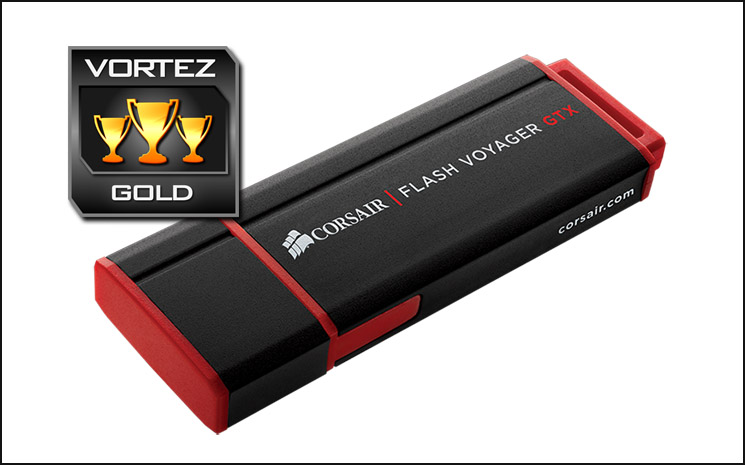
Flash Voyager GTX is unquestionably the fastest USB 3.0 flash drive we have yet tested. It pushes the boundaries for sequential read and write performance and arrives with useful SSD tech such as S.M.A.R.T and TRIM support – we have no qualms in handing out our prestigious gold award.
Pros
+ Super-fast transfer rates
+ Excellent build quality
+ S.M.A.R.T and TRIM ready
+ Attractive pricing
Cons
– Full potential requires Windows 8 or UASP enabled motherboard
– Wide dimensions could hinder other USB ports
+ Super-fast transfer rates
+ Excellent build quality
+ S.M.A.R.T and TRIM ready
+ Attractive pricing
Cons
– Full potential requires Windows 8 or UASP enabled motherboard
– Wide dimensions could hinder other USB ports

Click here for an explanation of our awards at Vortez.net.


